
This blog explores how signal-based targeting is transforming B2B prospecting in 2026, replacing outdated static contact lists. By leveraging real-time organisational and behavioural signals such as leadership changes, hiring trends, funding events, and technology adoption, B2B teams can engage prospects at the right time. The article highlights how signal-driven prospecting improves response rates, sales efficiency, pipeline quality, and compliance while reducing wasted outreach and inaccurate data.
B2B prospecting in 2026 is no longer a discovery problem. It is a timing problem. And for most UK and US marketing and sales teams, the data they are relying on to solve it is already dead.
With B2B contact data decaying at a rate of 25-30% per year (SiriusDecisions), the average static database loses a quarter of its accuracy every twelve months. Job titles change. Leadership teams restructure. Budgets shift mid-quarter. Strategic priorities evolve in weeks, not years.
The result is not just wasted spend. It is a compounding liability: burned sending domains, misdirected outreach, and sales teams chasing accounts with no active buying intent.
Signal-based B2B prospecting addresses this directly. By integrating real-time behavioural and organisational signals into targeting strategy, B2B teams are moving from broad-brush outreach to context-aware engagement - reaching the right accounts, not just the right-looking ones.
Traditional prospecting still relies on a formula that worked in 2010: Industry + Company Size + Geography + Job Title. In 2026, that formula is broken.
Here is what operating on stale B2B data actually costs UK marketing teams:
The issue is not your ideal customer profile. It is the absence of live context layered onto it.
When you are prospecting from a static list, you are not targeting - you are guessing.
Signal-based prospecting is frequently misunderstood as simply 'intent data.' In reality, it encompasses a broader set of real-time indicators that suggest organisational change, buying readiness, or strategic movement.
For UK and US B2B teams, actionable signals include:
Individually, no single signal confirms a buying decision. Collectively, they dramatically reduce uncertainty around timing and relevance.
The shift in how you frame targeting is subtle but commercially significant
From: 'Does this company match our ICP?' To: 'Does this company match our ICP AND is something happening here that makes outreach relevant right now?' That second question is what separates a prospect from a contact.
In complex B2B sales cycles, timing frequently determines outcome more than messaging quality or offer strength. Entering an account too early results in disengagement. Entering too late means competing against an incumbent already embedded in evaluation.
When outreach aligns with a live organisational trigger, the 'Why now?' is answered before the prospect opens the email. This changes the entire dynamic of the first conversation.
Signal-based targeting measurably improves four key performance areas:
1. Response Rates
Outreach aligned with visible organisational change resonates because it is contextual rather than generic. Messaging tied to a funding event, new executive appointment, or expansion initiative signals awareness - not volume.
2. Sales Efficiency
Sales teams spend less time pursuing accounts without active need and more time engaging prospects already experiencing momentum, transition, or urgency.
3. Pipeline Quality
When prospecting is aligned to organisational triggers, opportunity qualification improves. Conversations shift from exploratory to solution-oriented significantly faster.
4. Marketing-to-Sales Alignment
Shared visibility into account-level signals removes the classic handoff friction. Sales understands why an account was targeted - not just that it fits a demographic profile. That context changes how conversations start.
Timing, once treated as intuition or luck, becomes measurable, repeatable, and teachable.
As signal-based prospecting has grown in adoption, a common mistake has emerged: treating automated signal detection as a complete solution.
Automation can detect a signal. It cannot understand nuance.
The most effective GTM teams in 2026 use a blended approach: AI-driven signal detection paired with human-in-the-loop validation. Speed is a competitive advantage only when it is accurate speed.
For UK and US B2B marketing teams, signal-based prospecting carries a compliance obligation that cannot be treated as an afterthought.
Under UK GDPR (post-Brexit) and ICO guidelines, the sourcing, processing, and activation of B2B contact data must meet clear standards. This is particularly relevant when signals involve:
The legitimate interests basis - commonly relied upon for B2B outreach - still requires a documented balancing test, a clear suppression mechanism, and data minimisation practices.
At Merit, every dataset we build is constructed with compliance by design - not as a compliance checkbox, but as a commercial asset. Clean, compliant data protects your sender reputation, reduces legal exposure, and builds the kind of trust with prospects that scales.
High-performing B2B teams in 2026 treat signals as an additional intelligence layer within a governed marketing data framework - not a replacement for foundational data quality.
A resilient signal-based model for UK and US markets includes five core components:
1. Multi-Source Signal Aggregation
Signals are gathered from diverse, credible sources -including company filings, professional networks, news monitoring, job listing patterns, and technographic databases - to reduce blind spots and single-source bias.
2. Role and Account Validation
Before activation, contacts are verified against current role relevance, seniority, buying influence, and account structure. Hierarchy mapping ensures outreach reaches genuine decision-makers within the buying committee
3. Prioritisation Frameworks
Not all signals carry equal commercial weight. Structured scoring models distinguish high-impact buying triggers from background noise, allowing sales teams to focus effort where it will convert.
4. Continuous Refresh Cycles
Signals are time-sensitive assets. An event that created urgency last quarter may be entirely irrelevant today. Continuous refresh cycles prevent yesterday's signal from shaping tomorrow's outreach.
5. Compliance Controls
Clear governance policies ensure that data sourcing, interpretation, and activation remain aligned with UK GDPR, ICO guidelines, and regional privacy standards. Compliance is a feature of good prospecting, not a constraint on it.
Signal-based prospecting without these controls does not become faster - it becomes reckless.
The broader transformation underway in B2B lead generation is a move from static databases to dynamic, real-time targeting systems.
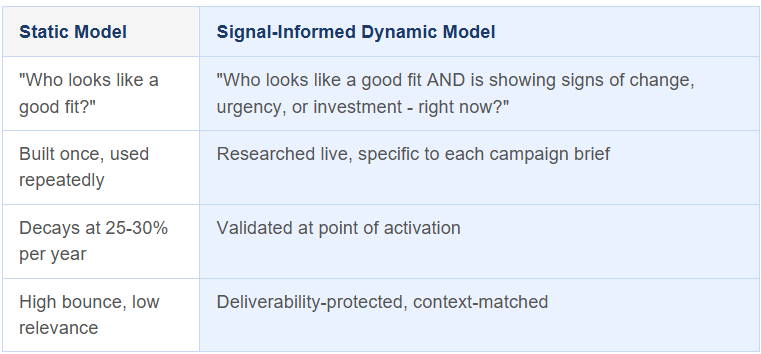
This evolution does not eliminate the need for clean, validated contact data. It makes it more essential. Signals are only actionable when layered onto accurate, current, campaign-ready records. Without reliable role validation, hierarchy mapping, and deliverability protection, the strongest signal in the world cannot translate into effective outreach
In the saturated UK & US B2B markets, messaging differentiation is increasingly difficult. Every vendor is sending personalised emails. Every sequence tool has AI-generated openers. Inbox noise is at an all-time high.
Context differentiation is different - and it cannot be automated. When outreach references a real organisational event, a verified leadership change, or a genuine strategic initiative your prospect is currently navigating, it demonstrates awareness. Not volume.
Over time, signal-informed outreach reduces:
More importantly, it builds commercial credibility. Prospects respond differently when engagement reflects their real world - not a template built around a job title.
Signal-based B2B prospecting is not a trend layer added on top of existing workflows. It is an operational shift in how B2B data is sourced, validated, and activated.
At Merit, we were built around this reality from day one. We do not maintain a static database. We do not recycle purchased lists. We do not automate without verifying.
Every dataset we deliver is researched live - to your ICP, your signals, your campaign brief - at the exact moment you need it.
Our approach combines:
Our database size? Zero. Because your contacts should be researched in real-time, specifically for the signals that matter to your business.
What is signal-based prospecting in B2B marketing?
Signal-based prospecting is a targeting methodology that uses real-time organisational and behavioural indicators - such as leadership changes, funding events, hiring patterns, and technology migrations - to identify accounts showing active buying readiness. Rather than targeting companies that match your ICP on paper, signal-based models target companies that match your ICP and are demonstrably in motion.
How does intent data differ from signal-based prospecting?
Intent data is one type of signal - typically referring to third-party web behaviour indicating research activity around a specific topic. Signal-based prospecting is broader, encompassing organisational signals (M&A, hiring, leadership changes), technographic signals (stack migrations, vendor reviews), and event-driven triggers. The most effective B2B targeting in 2026 combines multiple signal types rather than relying on intent data alone.
How quickly does B2B contact data decay?
Industry research indicates B2B contact data decays at approximately 25-30% per year. This means a list purchased twelve months ago may already have significant inaccuracies - wrong job titles, departed contacts, restructured teams.

