
Part 3 applies the architecture to M&A AI automation, contract re-evaluation pipelines, and SoW/KYC agent workflows in audit and compliance, closing with concrete audit trail KPIs technical leads can ship.
Parts 1 and 2 defined why traceable automation matters and what an audit-trail-first architecture looks like.
Now we translate those ideas into concrete workflows across four professional service contexts: M&A AI automation for legal due diligence, contract re-evaluation pipelines for ongoing compliance, SoW/KYC agent workflows in banking, and audit/compliance investigations.
M&A AI automation has already moved well past simple document summarisation. Deal teams now report roughly 40–45% efficiency gains in the analytical, document-heavy front end of transactions ; target screening, contract analysis, and diligence sprints ; even as judgment-intensive negotiation and integration work remains firmly human-led. The pattern holds across legal, audit, and compliance more broadly: agentic AI accelerates evidence collection, risk analysis, and drafting, while building richer, more granular audit trails than manual processes could ever produce.
The goal is not to remove human judgment but to turn partners into reviewers of well-structured AI reasoning instead of primary producers of first drafts ; and to make every one of those AI-assisted judgments defensible after the fact. That defensibility depends on two things this part will make concrete: workflow-specific implementation patterns (M&A, contract re-evaluation, SoW/KYC, audit investigations) and a shared set of audit trail KPIs that let technical leads and risk committees measure whether the audit-trail-first design is actually working in production.
We’ll cover four patterns:
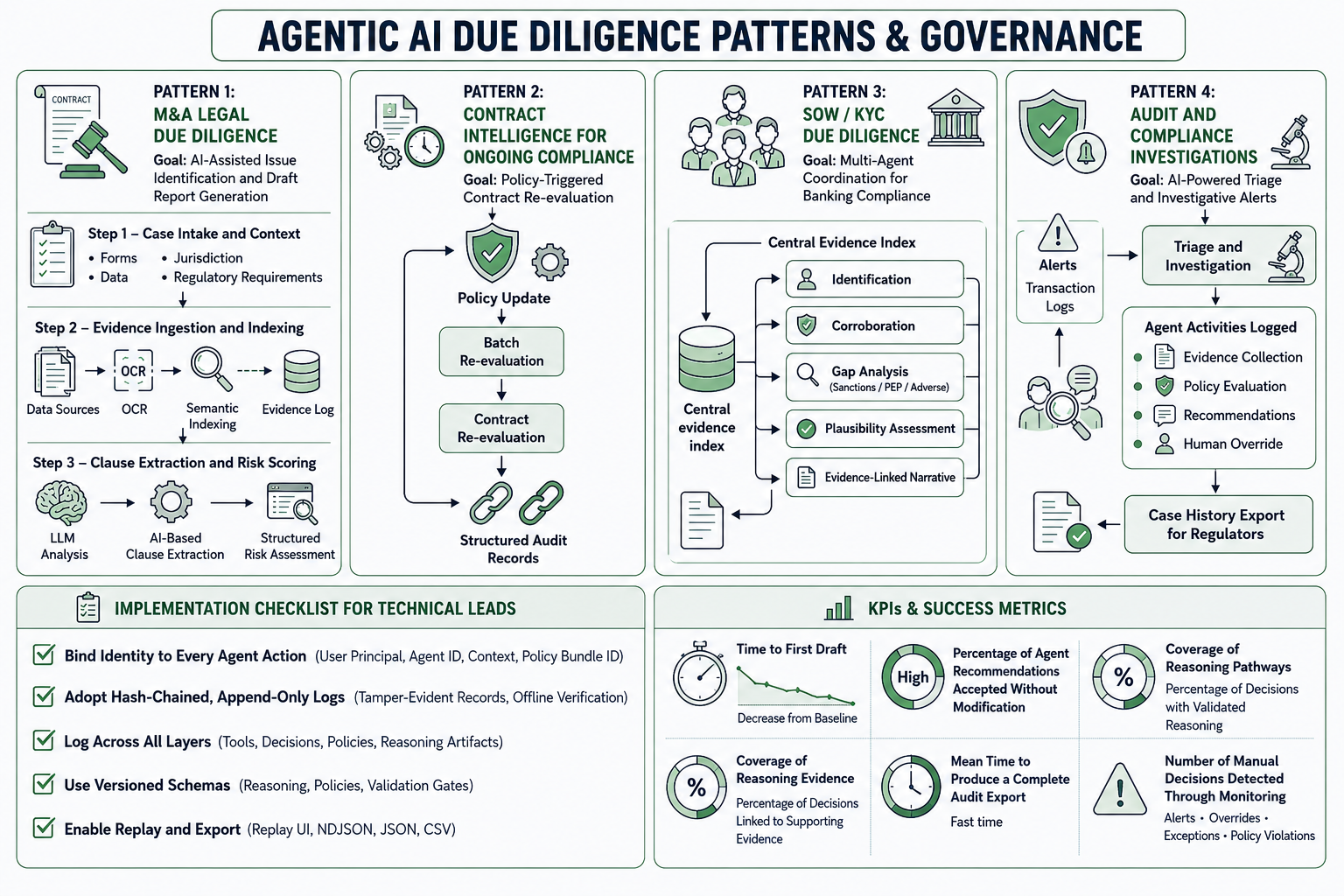
Goal: Generate an AI-assisted issue list and draft report over a data room, with partner-verifiable reasoning and full audit trails.
When a new deal engagement is created, capture a rich case context and bind it to all subsequent agent activity:
const ctx: AgentContext = {

  caseId: "DD-2026-042",

  userId: "usr_partner_01",

  userRole: "PARTNER",

  agentId: "ag_contract_risk_v3",

  agentVersion: "3.2.1",

  policyBundleId: "MNA_EU_US_2026_01"

};
Intake systems in legal and M&A tools store this metadata, including jurisdiction and regulatory regimes, to drive routing and policy selection.
Agents ingest documents from a data room, run OCR, and index them for semantic and keyword search but before any of that content becomes evidence an AI agent reasons over, the ingestion step must establish document provenance: proof that a specific byte-for-byte artifact entered the system at a specific time, plus enough spatial context to point a partner at the exact location on the page a clause was extracted from.
Security guidance for RAG and document pipelines is explicit on this point: hash every document at ingestion time (SHA-256 minimum), store the hash alongside metadata, and reject or flag anything that doesn't match on later retrieval ; this is what lets you later prove a contract wasn't silently swapped or altered between upload and the AI's risk scoring. Layout-aware document AI systems go a step further, capturing not just text but the bounding‑box coordinates of every word, line, and paragraph on the page, so any downstream extraction can be traced back to its exact spatial location rather than just "somewhere in this 80-page contract."
import hashlib

from dataclasses import dataclass

@dataclass

class BoundingBox:

    page: int

    x0: float

    y0: float

    x1: float

    y1: float

def sha256_of_file(path: str) -> str:

    h = hashlib.sha256()

    with open(path, "rb") as f:

        for chunk in iter(lambda: f.read(8192), b""):

            h.update(chunk)

    return h.hexdigest()

def ingest_document(

    case_id: str,

    path: str,

    audit: AuditLog,

    ocr_layout_fn,  # returns list[dict] with text + BoundingBox per element

) -> str:

    doc_id = str(uuid.uuid4())

    doc_checksum = sha256_of_file(path)  # provenance anchor

    layout_elements = ocr_layout_fn(path)  # OCR + spatial layout extraction

    spatial_layout = [

        {

            "element_id": str(idx),

            "text": el["text"],

            "bbox": el["bbox"],  # {page, x0, y0, x1, y1}

        }

        for idx, el in enumerate(layout_elements)

    ]

    payload = {

        "path": path,

        "doc_id": doc_id,

        "doc_checksum_sha256": doc_checksum,

        "spatial_layout": spatial_layout,

    }

    audit.append(

        case_id=case_id,

        agent_id="ag_ingest_v1",

        actor_id="sys_ingestion_worker",

        event_type="DOC_INGESTED",

        payload=payload,

    )

    return doc_id
Two fields in this DOC_INGESTED event are non-negotiable for provenance:
This pattern mirrors SoW due diligence systems, where each document is indexed with explicit provenance and anchored into the audit trail, and extends it with the checksum + spatial metadata that production document-AI pipelines increasingly treat as mandatory rather than optional.
Using the reasoning schema from Part 2, implement an extraction agent that calls an LLM and logs structured risk assessments:
def score_clause(

    case_id: str,

    clause_text: str,

    evidence_ref: dict,

    audit: AuditLog,

    reasoning_model,

) -> dict:

    # Call LLM to get structured reasoning (pseudo-code)

    reasoning = reasoning_model(clause_text, evidence_ref)


    validate_contract_risk(reasoning)

    audit.append(

        case_id=case_id,

        agent_id="ag_contract_risk_v3",

        actor_id="usr_associate_01",

        event_type="CLAUSE_RISK_SCORED",

        payload={"reasoning": reasoning},

    )

    return reasoning
Contract AI and due diligence tools emphasise that every extracted datapoint and risk assessment should be traceable back to source clauses and reasoning.
Goal: When policies change, re-evaluate existing contracts and surface cases with structured reasoning and partner approval trails.
// Define a versioned policy contract.
interface PolicyVersion {
  id: string;
  name: string;
  effectiveFrom: string;
  rules: any; // Replace with your DSL, OPA/Rego, or JSON rules type.
}

// Create the new policy version to apply during re-evaluation.
const newPolicy: PolicyVersion = {
  id: "pol_residency_v2",
  name: "Data Residency Policy v2",
  effectiveFrom: "2026-07-01T00:00:00Z",
  rules: {
    // Define residency requirements, exceptions, and review triggers here.
  },
};
Policy engines for AI agents often use versioned bundles, and audit logs must record which version was in force for each decision.
Architectural consideration: asynchronous parallel processing
A policy update rarely affects one contract : it typically triggers re-evaluation across a repository of thousands of historical agreements. Running that re-evaluation synchronously inside the request/response cycle that fired the policy update is a non-starter: it would block on LLM calls and document retrieval for hours, has no resumability if a worker crashes midway through contract #4,200, and gives you no backpressure control when the risk model or vector store gets overloaded.
The correct pattern is to decouple triggering from execution using event queues and let a fleet of stateless batch workers pull work independently. Two common architectures fit this:
Either way, the key architectural rule is that each batch worker pushes its own state events back to the central AuditSink as it progresses : not just a final success/failure signal. That means every worker emits CONTRACT_POLICY_EVAL_STARTED, intermediate CONTRACT_POLICY_EVAL_RETRY events on transient failures, and a terminal CONTRACT_POLICY_EVAL_COMPLETED/FAILED event, all correlated to the same policyBundleId and a shared batchRunId so a partner or auditor can reconstruct the full sweep: including partial failures and retries : months later, not just a summary count of "3,412 contracts processed."
// worker.ts — one Celery/Temporal activity per contract

async function reevaluationWorker(

  ctx: AgentContext,

  contractId: string,

  policy: PolicyVersion,

  batchRunId: string,

  sink: AuditSink

) {

  const workerCtx = { ...ctx, policyBundleId: policy.id };

  await sink.append({

    eventId: randomUUID(),

    occurredAt: new Date().toISOString(),

    context: workerCtx,

    eventType: "CONTRACT_POLICY_EVAL_STARTED",

    inputSummary: JSON.stringify({ contractId, batchRunId }),

    outputSummary: "",

  } as any);


  try {

    const result = await evaluateContractAgainstPolicy(workerCtx, contractId, policy, sink);

    await sink.append({

      eventId: randomUUID(),

      occurredAt: new Date().toISOString(),

      context: workerCtx,

      eventType: "CONTRACT_POLICY_EVAL_COMPLETED",

      inputSummary: JSON.stringify({ contractId, batchRunId }),

      outputSummary: JSON.stringify(result),

    } as any);

    return result;

  } catch (err) {

    // Celery/Temporal retry policy handles re-delivery;

    // this event just makes the retry visible in the audit trail

    await sink.append({

      eventId: randomUUID(),

      occurredAt: new Date().toISOString(),

      context: workerCtx,

      eventType: "CONTRACT_POLICY_EVAL_RETRY",

      inputSummary: JSON.stringify({ contractId, batchRunId, error: String(err) }),

      outputSummary: "",

    } as any);

    throw err; // re-throw so the queue/workflow engine handles redelivery

  }

}async function evaluateContractAgainstPolicy(
ctx: AgentContext,
contractId: string,
policy: PolicyVersion,
sink: AuditSink
) {
const wrapped = withAuditTrail(
{ ...ctx, policyBundleId: policy.id },
sink,
"CONTRACT_POLICY_EVAL",
async () => {
// pseudo: fetch clauses & run risk model
const reasoning: ReasoningArtifact = await runRiskModel(contractId, policy);
const result = { contractId, policyId: policy.id, recommendation: "REVIEW" };
return { result, reasoning };
}
);
return wrapped();
}
This pattern matches real implementations where policy changes trigger batch re-evaluation of contracts and generation of structured audit records.
The SoW agentic blueprint includes multiple agents (identification, corroboration, gap analysis, plausibility, narrative) coordinating over an evidence index.
Here’s how you might log gap analysis and narrative generation.
def gap_analysis(

    case_id: str,

    evidence_index: list[dict],

    expected_categories: list[str],

    audit: AuditLog,

) -> dict:

    present = {e["category"] for e in evidence_index}

    missing = [c for c in expected_categories if c not in present]


    reasoning = {

        "schema_version": "sowGap.v1",

        "missing_categories": missing,

        "evidence_refs": evidence_index,

    }


    audit.append(

        case_id=case_id,

        agent_id="ag_sow_gap_v1",

        actor_id="sys_sow_orchestrator",

        event_type="SOW_GAP_ANALYZED",

        payload={"reasoning": reasoning},

    )

    return reasoning
The published SoW agent system logs multi-phase reasoning, including gap analysis, in a structured way to support later replay and evaluation.
def sow_narrative(

    case_id: str,

    corroboration: dict,

    gaps: dict,

    audit: AuditLog,

    llm_client,

) -> str:

    prompt = {

        "corroboration": corroboration,

        "gaps": gaps,

    }

    # LLM sees structured data, not raw docs

    narrative = llm_client.generate_sow_summary(prompt)


    audit.append(

        case_id=case_id,

        agent_id="ag_sow_narrative_v1",

        actor_id="usr_compliance_analyst_01",

        event_type="SOW_NARRATIVE_DRAFTED",

        payload={

            "input_summary": prompt,

            "narrative": narrative[:2000],

        },

    )

    return narrative
The SoW paper emphasises evidence-linked narratives where each assertion can be traced back to specific documents and corroboration steps.
Transactions, logs, and external feeds yield alerts which agentic workflows can triage and investigate.
Design guides for AI agent logging stress that each step—evidence pull, policy evaluation, recommendation, human override—must be logged for audit.
interface InvestigationEvent {

  eventId: string;

  occurredAt: string;

  caseId: string;

  alertId: string;

  stage:

    | "INTAKE"

    | "EVIDENCE_GATHERING"

    | "RISK_SCORING"

    | "DECISION"

    | "HUMAN_REVIEW";

  actorId: string;

  actorType: "AGENT" | "HUMAN";

  details: Record<string, unknown>;

}
Data privacy and redaction: sanitize before you hash
Investigation logs are the highest-risk log category in this whole architecture, because details in the interface above almost inevitably ends up holding raw API payloads, transaction records, KYC documents, hotline transcripts , that contain PII or PHI. Writing that raw content directly into a hash-chained, append-only ledger is a serious compliance mistake: unlike a normal database row, you generally cannot delete or edit a chained audit record without breaking every subsequent hash, so any PII that lands in the chain is effectively permanent, defeating GDPR erasure rights and HIPAA minimum-necessary requirements by design.
The fix is to insert an automated PII/PHI Redaction Sanitizer as a mandatory middleware step before hashing, not after so sensitive values never enter the cryptographic chain in the first place. This must happen at the point of capture (the logging SDK or an inline gateway), not as a downstream cleanup pass, because once raw content is durably persisted, redacting it later doesn't undo the exposure.
Three redaction strategies, and when to use each:
// piiSanitizer.ts

import { createHash, createHmac } from "crypto";

const SENSITIVE_KEYS = new Set([

  "ssn", "passport_number", "account_number", "password", "api_key",

  "date_of_birth", "email", "phone", "full_name",

]);

const EMAIL_PATTERN = /[\w.+-]+@[\w-]+\.[\w.-]+/g;

const HASH_SALT = process.env.PII_HASH_SALT ?? ""; // required in production

function hmacDigest(value: string): string {

  return "hmac:" + createHmac("sha256", HASH_SALT).update(value).digest("hex").slice(0, 16);

}

export function sanitizePayload(payload: Record<string, unknown>): Record<string, unknown> {

  const clean: Record<string, unknown> = {};

  for (const [key, value] of Object.entries(payload)) {

    if (SENSITIVE_KEYS.has(key.toLowerCase())) {

      clean[key] = typeof value === "string" ? hmacDigest(value) : "[REDACTED]";

      continue;

    }

    if (typeof value === "string") {

      clean[key] = value.replace(EMAIL_PATTERN, (m) => hmacDigest(m));

    } else if (typeof value === "object" && value !== null) {

      clean[key] = sanitizePayload(value as Record<string, unknown>);

    } else {

      clean[key] = value;

    }

  }

  return clean;

}


// auditSink.ts — sanitize is the mandatory first step, hashing is the second

export async function appendInvestigationEvent(

  sink: AuditSink,

  raw: InvestigationEvent

) {

  const sanitized: InvestigationEvent = {

    ...raw,

    details: sanitizePayload(raw.details), // PII/PHI stripped BEFORE hashing

  };

  // chain_hash / content_hash is computed over `sanitized`, never over `raw`

  await sink.append(sanitized as any);

}
This ordering matters mechanically, not just procedurally: because the hash chain is computed over whatever payload is actually passed to append(), running the sanitizer first means the chain's cryptographic integrity is computed over the redacted, compliant payload verifying the chain later proves the sanitized record hasn't been altered, without ever requiring the original raw PII to exist in the ledger at all. For AI-gateway-style architectures, this same pattern is described as writing a "content-free" hash-chained audit log the log proves an event happened and that its content hasn't changed since, without the ledger ever holding the sensitive content itself. Keep the field-level classification list (SENSITIVE_KEYS) centrally maintained and version it alongside your reasoning and policy schemas, since new PII/PHI field types tend to appear as new data sources are onboarded.
async function riskScoreAlert(

  alertId: string,

  ctx: AgentContext,

  sink: AuditSink

) {

  const eventId = randomUUID();

  const occurredAt = new Date().toISOString();


  const score = await computeRiskScore(alertId); // pseudo

  const record: InvestigationEvent = {

    eventId,

    occurredAt,

    caseId: ctx.caseId,

    alertId,

    stage: "RISK_SCORING",

    actorId: ctx.agentId,

    actorType: "AGENT",

    details: { score }

  };


  await sink.append(record as any);

  return score;

}
AML and fraud tools built on agentic workflows log every investigation phase, making it easy to export a case history that regulators can inspect.
Putting it all together, your due diligence platform should:
#integrity_watchdog.py — run on a scheduler (cron, systemd timer, or Celery beat)

import logging from datetime import datetime, timezone

logger = logging.getLogger("audit_integrity_watchdog")

def run_integrity_check(audit: "AuditLog", alert_sink) -> bool: is_valid = audit.verify_chain() checked_at = datetime.now(timezone.utc).isoformat()

if not is_valid:
    alert_sink.page_secops(
        severity="CRITICAL",
        message=f"Audit chain integrity check FAILED at {checked_at}. "
                 f"Hash mismatch detected — possible tampering or data loss.",
    )
    logger.critical("AUDIT_CHAIN_BROKEN checked_at=%s", checked_at)
else:
    logger.info("AUDIT_CHAIN_OK checked_at=%s event_count=%d", checked_at, len(audit._events))

return is_valid
This closes the loop between Part 1's tamper-evident design and Part 2's identity-bound logging layers: a broken chain is detected in minutes rather than discovered or missed entirely during a regulatory inspection months later
To demonstrate value and safety to partners and risk committees, track:
Why report these two together: Schema Compliance Rate catches whether the agent's output has the right shape; Traceability Coverage catches whether the content inside that shape is actually anchored to real evidence. Structured-output research shows these are genuinely separate failure modes a model can produce a syntactically perfect, schema-valid JSON object that still contains a value with no grounding in the source document, and schema validators alone won't catch it. Tracking both closes that blind spot and gives risk committees a metric pair that maps directly to "is the AI's output well-formed" versus "is the AI's output actually true to the evidence."
Controlled agentic workflows for due diligence are about turning AI into a traceable collaborator whose actions and reasoning can be inspected, challenged, and defended.
By combining structured reasoning schemas, hash-chained audit logs, identity-bound events, and explicit human approval gates, you get automation that meets the expectations of regulators, clients, and your own partners.
If you wire your M&A, contract intelligence, SoW/KYC, and audit workflows with these patterns and code-level practices, you’ll have a platform where an AI agent’s decision trail is as robust and more reconstructable than any human-only process you’ve run before.

